
Family
A family is considered the basic unit of society, and it plays a very important role in the life of every individual.
From the very beginning of human history, family has been the place where people were born, raised, protected, and
taught basic values. It is mainly a social group made up of people who are biologically related, but in modern society
it can also include people connected through marriage, adoption, or partnership. Family represents the first environment
where a person learns how to communicate, behave, and live among others. Because of this, family values have always been
highly important and continue to shape society even today.

Traditionally, family included a wider group of relatives, such as grandparents, parents, children, uncles, aunts,
and cousins. These family ties were very strong, especially in the past, when people often lived close to each other
or even in the same household. Nowadays, family structures have changed significantly, but the importance of family
has not disappeared. It has only taken new forms. The most common family type today is the nuclear family, which consists
of parents and their child or children. This type of family is typical mainly in urban areas, where people focus more
on work, education, and individual lifestyles.
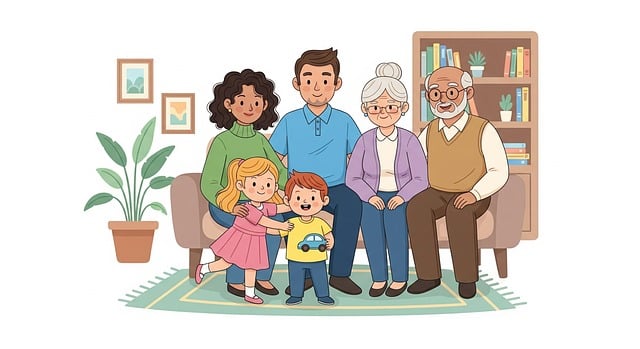
Another type of family is the extended family, which includes relatives from more than two generations. This family
type used to be very common in the past, especially in rural areas. Grandparents often lived together with parents and
children, and they played an important role in raising children. They passed on traditions, values, and life experience.
Today, extended families are less common, but they still exist, mainly in cultures where family bonds are very strong.
In modern society, contact with extended family members is often limited because of distance, work obligations, or busy lifestyles.
Single-parent families are becoming more common today. In this type of family, children live with only one parent, usually
because of divorce, separation, or death of one parent. These families often face many challenges, especially financial and
emotional ones. The single parent has to take care of children, work, and manage the household alone, which can be very demanding.
Because of this, single-parent families often need support from relatives, social services, or the state. Despite these difficulties,
many children from single-parent families grow up to be responsible and independent individuals.
Reconstituted families, also known as stepfamilies, are formed when divorced or widowed people marry again. In these families,
children may live with one biological parent and a stepparent. They may also gain stepsiblings or half-siblings. Life in
stepfamilies can sometimes be complicated, because family members need time to adjust to new roles and relationships. On the
other hand, these families can also provide children with new opportunities, care, and emotional support. Mutual respect and
good communication are very important for the healthy functioning of reconstituted families.
In recent years, same-sex families have also become more visible, especially in liberal and democratic societies. These families
are formed by partners of the same sex, and in some countries, they have the right to marry and adopt children. Just like other
families, same-sex families provide love, care, and emotional support to their children. Although they are still sometimes a
subject of debate, they are an example of how family structures are changing in the modern world.
Family is extremely important because it provides emotional security and support. Family members are usually the closest people
in our lives, and we can rely on them in difficult situations. Family supports us not only in childhood but also later in life,
when we face problems related to work, health, or relationships. One of the most important roles of family is shaping personality.
Parents are the first role models for their children, and their behavior strongly influences how children see the world and themselves.
Family relationships exist between people of the same age, such as siblings or spouses, as well as between different generations, such as parents and children or grandparents and grandchildren. Siblings play an important role in childhood development. Children with brothers or sisters learn how to share, cooperate, compete fairly, and solve conflicts. Having an older sibling can be an advantage, because younger children can learn social skills and problem-solving strategies by observing them.
Grandparents also have an important place in family life. Although their influence may not be as strong as it was in the past, many grandparents are actively involved in their grandchildren’s upbringing. They often help parents with childcare and enjoy spending time with children. Grandparents like to share their life experience, stories, and traditions. For many people, memories of time spent with grandparents belong among the most beautiful childhood memories.
Parents raise their children in different ways, which is described by various parenting styles. One of them is the authoritarian
style. Authoritarian parents are very strict and expect complete obedience from their children. They usually do not allow discussions
and often use punishment if children do not follow rules. This style can lead to fear, low self-esteem, and lack of independence in
children.
Another parenting style is the democratic style, which is considered the most balanced and effective. Democratic parents set clear
rules, but they are open to discussion and explain their reasons to their children. Children feel respected and valued, and they learn
that freedom comes with responsibility. This parenting style helps children develop self-confidence, independence, and respect for
others.
The liberal parenting style is characterized by too much freedom. Liberal parents are very permissive and allow children to do almost
whatever they want. They often do not set clear boundaries or rules. As a result, children may grow up to be irresponsible, selfish,
or inconsiderate of others. Although this style may seem friendly, it can have negative effects on a child’s development.
The last parenting style is the over-caring or overprotective style. Parents who follow this style worry too much about their children
and try to protect them from every possible danger. While their intentions are good, this behavior can prevent children from becoming
independent and confident adults. Overprotected children may have difficulties making decisions or coping with problems later in life.
Family fulfills several important functions in society. One of them is the biological function, which is related to reproduction and
having children within family units. Another function is the economic function. Parents are responsible for providing basic needs such
as food, clothing, housing, healthcare, and education. Family members usually share finances and support each other economically.
The emotional function of family is also very important. Family is the place where people receive love, care, understanding, and
emotional support. It is also where children learn how to express and control emotions such as anger, fear, happiness, or sadness.
Emotional support from family helps individuals cope with stress and difficult life situations.
Another important function is the educational function. Family is the first place where children learn their mother tongue, basic
behavior, moral values, and social norms. Parents teach children what is right and wrong, how to behave politely, and how to respect
others. Although schools play an important role in education, family remains the foundation of a child’s learning process.
Family life in the modern world has changed significantly due to social, economic, and cultural changes. Today, people tend to get
married later and have fewer children. One of the main reasons is the increasing importance of education and career success for both
men and women. Many couples prefer to focus on their careers before starting a family.
Cohabitation has also become more common. Many couples live together without getting married, which was considered unacceptable in the
past. Divorce rates have increased as well, and marriages often end because of financial problems, lack of communication, infidelity,
or incompatible lifestyles. As a result, family structures are becoming more diverse.
Another important change is the sharing of household duties. In the past, women were mainly responsible for housework and childcare.
Today, since many women have careers, domestic responsibilities are more equally shared among parents and even children. This change
promotes equality and teaches children responsibility from an early age.
In conclusion, family remains one of the most important institutions in society, even though its forms and roles have changed over
time. Family provides emotional support, education, and stability, and it helps shape personality and values. Despite modern
challenges such as divorce, busy lifestyles, and changing social norms, family continues to be a key part of human life and society.

Obrázky použité na tejto stránke sú čerpané zo stránky:
pixabay.com